
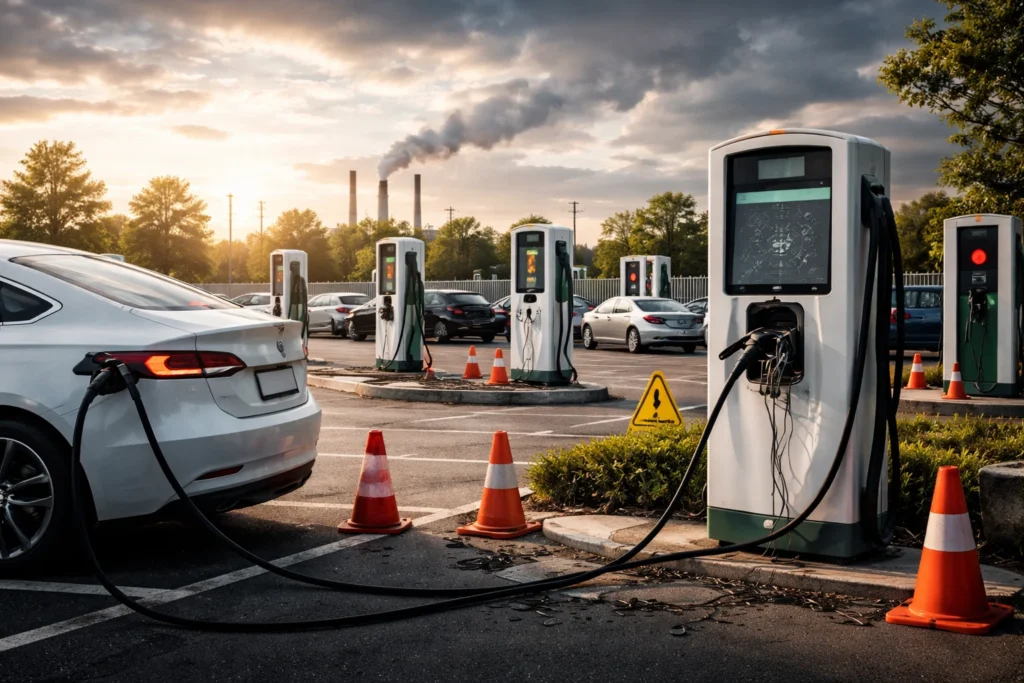
EV adoption stalls because high upfront costs, range anxiety, and lack of trust in charging reliability still discourage many buyers.
Australia sold 103,269 electric vehicles in 2025, and that represents just 8.3% of total new car sales. Still, buyers keep walking past EVs on dealership lots and choosing petrol cars, even when charging stations doubled across major cities during the same period.
In this article, we’ll break down the five main reasons why EV adoption stalls even when charging options exist. We’ll also discuss how broken chargers destroy driver confidence, policy confusion around fringe benefits tax, and the equity gaps that lock out renters entirely.
Let’s find out everything about the underlying problems of Australia’s electric vehicles.
Main EV Adoption Barriers When Charging Stations Already Exist
Unreliable charging infrastructure, policy uncertainty, and grid capacity limitations are the main reasons why EV adoption stalls. This is something nobody talks about: infrastructure exists, but drivers don’t trust it to work when they need it. And the problem doesn’t just stop at building more stations.
Here are the three main issues that create barriers for potential EV buyers.
Problem With EV Charging Infrastructure
On this issue, governments face a tricky question: should they fund charging stations or subsidise EV purchases first? However, research shows that sponsoring charging stations proves more cost-effective than sponsoring EV purchases for early adopters.
Basically, charging availability and vehicle sales depend on each other, and create a cycle that slows EV adoption. Again, wealthier early adopters already have home charging. And that makes public infrastructure less appealing to the people buying EVs right now.

Charger Anxiety Outweighs Range Anxiety for EV Drivers
The good news is modern EVs have plenty of range. But the bad news is you can’t trust the chargers. Most electric vehicles travel over 400km per charge, yet drivers still fear running out.
After working with hundreds of Australian EV owners, we’ve noticed the real concern isn’t battery range. Rather, the worry centres on whether the charger will actually work when you pull up to use it.
In fact, studies found that 70% of EV users encountered broken public chargers within six months of ownership. Overall, the lack of staff, lighting, and surveillance makes charging stations feel unsafe (especially at night when you’re standing alone in an empty car park).
Grid Capacity Stops Charging Infrastructure Investment
Installing fast chargers sounds simple until you realise the local grid can’t handle the load. Particularly, peak charging times put pressure on local grid infrastructure. This causes hesitation from energy providers who’d otherwise expand networks faster.
To top that, upgrading substations and transformers costs millions before installing a single charging station (typically $10-25 million for regional fast-charging infrastructure). It’s one of the reasons why rural and outer-suburban areas face the biggest grid capacity challenges for fast chargers. Plus, their electrical infrastructure was built decades ago for much lower demand.
EV Charging Station Reliability Is More Important
Having 500 charging stations means nothing if 350 of them don’t work when you need them. And the bitter truth is, one terrible charging experience outweighs twenty good ones. For example, broken chargers, incompatible payment systems, and zero customer support destroy driver confidence.
Usually, petrol stations have staff, working equipment, and consistent experience. Meanwhile, EV charging stations often have none of this. One bad charging experience keeps potential buyers in petrol vehicles for years, especially when the purchase costs $50,000 or more.
Unfortunately, drivers remember the time they couldn’t charge at Westfield, or had to download three different apps just to access various charging networks (no one would forget waiting 45 minutes only to find the charger completely dead).
Even the Electric Vehicle Council reported that charging reliability remains the top concern among potential EV buyers in Australia. That meansquantity solves nothing when quality remains this inconsistent across networks.
Policy Changes That Influence EV Adoption
Did you know that Australian EV policy changed more in 2024-2025 than in the previous five years combined? Yes, that’s true.
Federal and state governments introduced new incentives, removed old ones, and proposed charges that completely pivot the economics of electric vehicle ownership through these changes.

Take a look at the three major policy changes.
FBT Exemption Changes Hit PHEVs in April 2025
The fringe benefits tax exemption made EVs financially attractive for salary packaging and business use.
Because of that, PHEVs lost this tax advantage overnight (which put dealerships in a pickle with customers who’d already ordered vehicles). Although pure EVs still qualify, the policy change confused both buyers and dealerships about which vehicles remain eligible.
Proposed Road User Charges and Their Effect on EV Adoption
What happens when EVs lose their highest running cost advantage over petrol cars? Well, they could become less appealing, which would slow adoption and bring running costs closer to traditional vehicles.
To solve this, the Federal Government plans distance-based charging to replace the declining fuel excise revenue from petrol cars. So, the charge would match what petrol drivers pay, which takes away one of the biggest EV financial perks.
With this policy, regional drivers might get concessions, but urban EV owners face new ongoing costs that weren’t part of their original purchase calculations.
Equity Gaps Leave Low-Income Communities Behind
Usually, wealthy suburbs get multiple charging options while renters and low-income areas get left behind. Most charging stations cluster in one area, leaving environmental justice communities without access to the infrastructure needed for EV ownership.
What’s more, renters and apartment dwellers can’t install home chargers. This forces reliance on sparse public infrastructure. Without equitable charging access, renters miss the boat on EV ownership completely(no home charging means no practical way to own an electric vehicle).
Smart Mobility Solutions For Electric Vehicles
The most effective way to fix charging problems is to use the grid better. Smart mobility focuses on reducing emissions through better technology integration and shared transport options. These solutions address the root causes instead of just adding more infrastructure that might sit unused during off-peak hours.
Here’s how mobility solutions can improve drivers’ experience.
Vehicle-to-Grid Technology and Load Balancing
What if your EV could earn money by selling power back to the grid during peak times? Yeah, that’s possible. Vehicle-to-grid technology lets EVs return electricity to the grid during peak demand periods, and your car becomes a mobile energy storage unit.
Plus, off-peak charging incentives lower electricity costs for drivers and ease pressure on the grid simultaneously. Meanwhile, workplace chargers spread demand throughout the day instead of concentrating it in the evenings when everyone gets home and plugs in at once.

Car Sharing and Multi-Modal Transport Options
Car sharing allows people to try EVs without paying high upfront costs or committing to long-term ownership. For example, someone can use a shared EV for weekend trips or errands and decide later if owning one suits their lifestyle.
Along with that, linking EVs with public transport makes them more useful for short trips and getting to and from stations in cities like Melbourne and Brisbane. When this is combined with safe walking and cycling paths, fewer people rely on private cars for every journey.
Eventually, it creates a more sustainable transport system instead of simply replacing one type of car with another.
Time to Rethink What’s Really Holding EVs Back
The barriers to EV adoption are less about a lack of charging stations and more about reliability and accessibility. Specifically, broken chargers, policy confusion, and equity gaps cause greater problems than a lack of infrastructure would.
Solutions exist, but they require honest conversations about what’s broken instead of just building more of what already doesn’t work. In the end, fixing charger reliability is more important than adding another hundred stations that might fail when drivers need them most.
EVoasis provides charging solutions designed for reliability and compatibility across all EV brands. Visit us to know more about charging options that are backed by responsive customer support and proven Australian weather-resistant technology.