
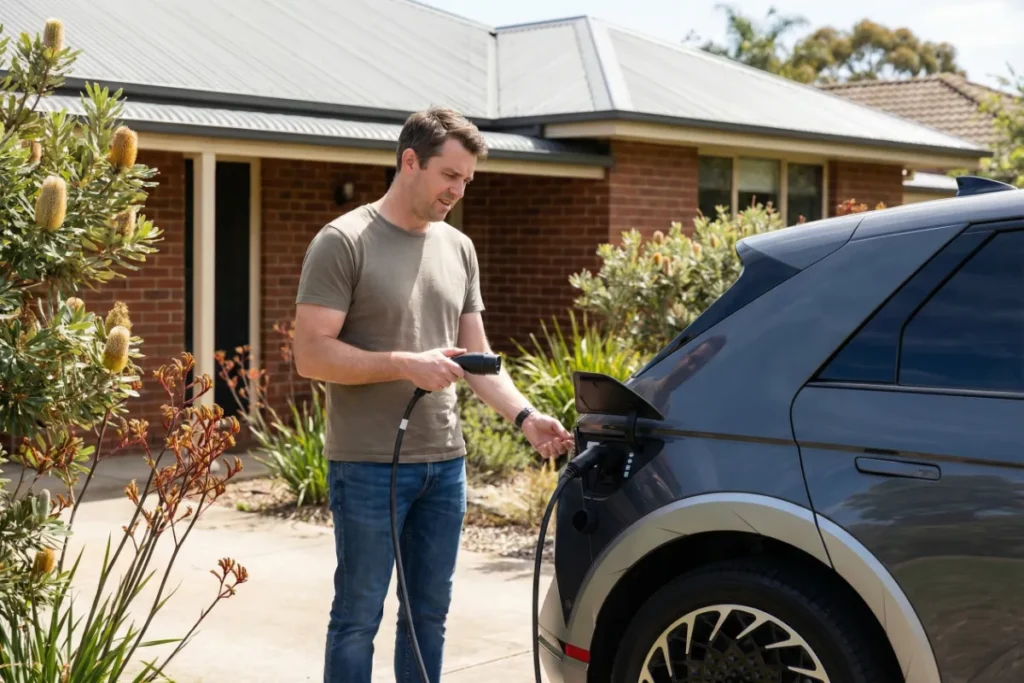
Getting your first electric vehicle is exciting. But then you get home and realise you’ve got questions: How do I charge this thing? Will I run out of battery on the freeway? Is there anything I should avoid doing?
Don’t worry, we’re here to answer all your queries. At EVoasis, we’ve helped thousands of Aussie drivers handle those first few weeks.
In this guide, we’ll cover:
- How home charging works
- How to use public chargers around Australia
- What regenerative braking feels like
- Why the real-world range differs from what’s in the brochure
- Simple habits to keep your battery healthy
Ready? Let’s begin.
How Do You Charge an EV at Home?
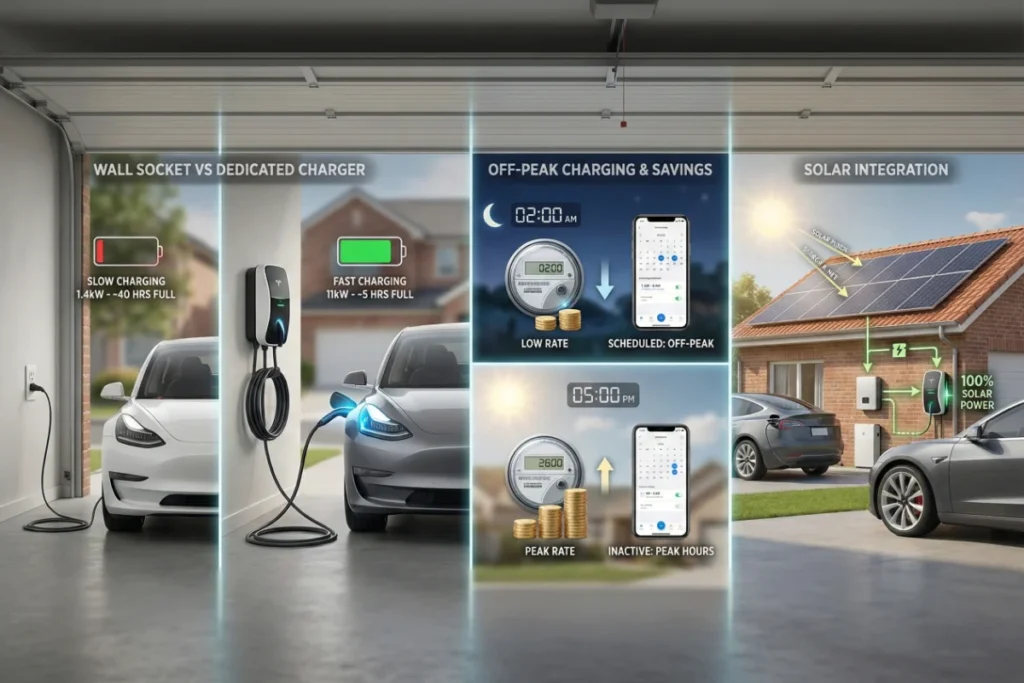
You charge your EV at home by either plugging it into a standard outlet or installing a wallbox charger in your garage. Both options work perfectly, but the right choice depends on how far you intend to drive every day.
We’ll now explain your options.
Wall Socket vs Dedicated Charger
A dedicated EV charging system like a wallbox has a higher upfront cost, sure, but it can save you lots of time each week.
Here’s what we mean by that. A standard power outlet (the regular plug you already have at home) gives you about 10 km of EV range per hour. That’s fine for short trips.
But if your day-to-day driving is about 50 km, you’d need roughly five hours of charging just to reload the amount you’ve used.
That’s why many electric vehicle owners switch to a 7 kW wallbox. It gives you roughly 40 km per hour, so you can plug in after dinner and wake up with a full battery.
Charging Levels Explained
Have you ever wondered why some chargers take hours, and others take only minutes to refill your battery?
In reality, it all comes down to power and the type of electric vehicle supply equipment you’re using. Specifically, there are three charging levels: Level 1, Level 2, and Level 3.
Level 1 uses a standard outlet and charges your car slowly over many hours. Level 2 refers to your typical home EV charging wallbox or public AC charger, and it’s a perfect pick for overnight top-ups (we’ve discussed both in the previous section).
Then there’s Level 3. Believe it or not, these DC fast chargers can add 100 km of range in around 20 minutes. You’ll find them at public fast-charging stations, which means they’re brilliant for road trips.
But Level 3 charging comes with a twist: it’s not great for your EV batteries if you use it every day. The extra heat a fast charger generates will wear out your battery more quickly over time.
Set Up Off-Peak Charging to Save Money
Many people still don’t know that charging an electric vehicle during off-peak times (typically late at night) can lower their electricity costs considerably.
The way it works is that most electricity providers charge less overnight. So if you’re plugging in at peak times, you’re paying more than you need to. But if you move your charging time to off-peak hours, the savings add up fast.
Plus, you don’t need to think about it too much because a lot of the EV models let you schedule your charging time in the app. Simply set the timing once and forget about it. The car will automatically start charging during off-peak hours (which also helps reduce pressure on the electricity grid).
And if you’ve got rooftop solar, it’s even better. Charge during the day when the sun is out, and your running costs almost drop to nothing.
Pro tip: Check your switchboard capacity before installing a wallbox to avoid overloading your home setup.
How Do You Use Public Chargers in Australia?
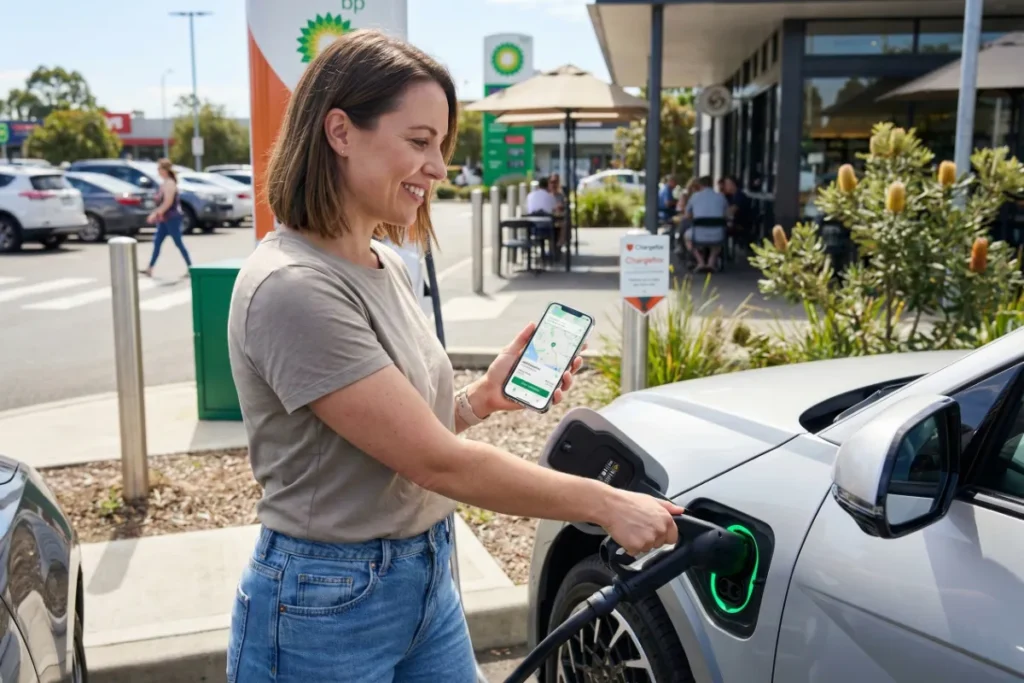
Just download a charging app, find a nearby station, tap to pay, and plug the charger into your car. As you can see, it’s simpler than you’d expect. And the best part is that the public charging network is growing bigger every day, with the Electric Vehicle Council reporting new sites opening all across Australia.
Follow the steps below to charge your EV at a public charging station:
- Get a Charging Location App: You need an app to find the locations of charging stations, and PlugShare is the one most EV drivers start with. It shows every public charger in Australia on one map. What’s more, it’s a complete app with user reviews and real-time availability.
- Set Up Accounts Before You Need Them: Different apps require individual accounts and payment systems. For instance, Chargefox and Evie Networks have their own apps for payment. Make an account for each one and add your card so you’re not stuck at public EV chargers with a low battery.
- Plan Your Stop Around a Coffee or Meal: Most charging sessions take 20 to 40 minutes on a DC fast charger. That’s enough time to stretch your legs at Macca’s or grab a flat white.
- Check Your Connector Type: Nearly all new EVs in Australia use Type 2 for AC and CCS2 for DC fast charging. Older Japanese imports like the Nissan Leaf might need CHAdeMO, which is less common now.
- Tap, Plug, and Go: Some stations need the app to start charging, and others let you tap your card to pay. Either way, your phone or the car’s screen will show the charging progress live.
- Know Who’s Who: If you want smoother stops on your EV journey, you should know who the major networks are. Chargefox is the biggest one with over 900 locations. Tesla Superchargers now let most EVs plug in. And Evie works with BP and Red Rooster to give you easy access to public chargers on the road.
Honestly, it’s just plugging in, relaxing for a bit, then hitting the road.
How Does Driving an EV Feel Different?
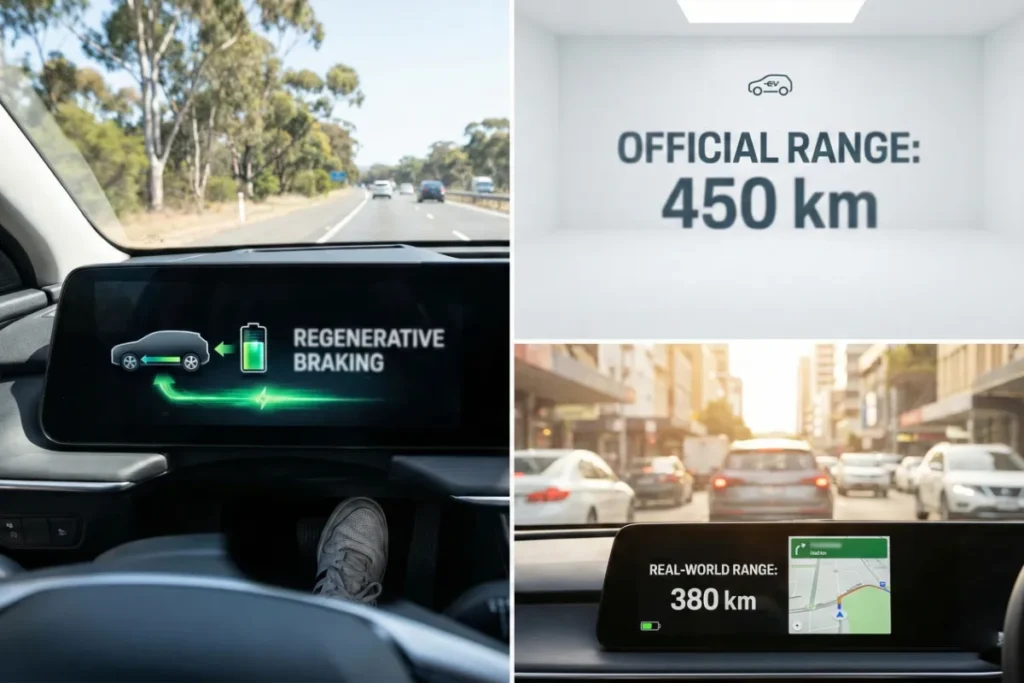
Electric cars feel different because they respond faster than an internal combustion engine car, have regenerative braking, and are almost silent. It takes a bit of getting used to, but every EV owner loves it within a week.
Let’s get into more detail about how driving EVs is different.
Regenerative Braking and One-Pedal Driving
Ever driven a car that slows down as soon as you lift your foot? That’s regenerative braking, which makes the electric motor work in reverse the moment you release your accelerator. Then it sends energy back into the battery, which slows the car without you touching the brake pedal. And you can optimise how strong the effect feels, from very soft to quite firm.
One important thing. You may face some issues getting used to this practice at the beginning. But after a few days, it will become natural, and you’ll hardly touch the brakes at all.
And that’s why it’s called one-pedal driving… You can control your electric car with just the accelerator.
The Difference Between Real Range and Paper Range
It’s important to know the real figures before you go out because the number on the brochure and the number you get in your electric car often aren’t the same.
For example, the “450 km range” on the sticker comes from a lab test called the Worldwide Harmonised Light Vehicle Test Procedure (WLTP). That test uses perfect conditions, like flat roads and steady speeds (no bumps, no heat, no traffic… Imagine!).
But real driving in Australia is very different. Let’s say you’ve got the air conditioning on in a Perth summer or are sitting on the freeway at 110 km/h. Your range will drop for sure.
As a rule of thumb, we recommend expecting about 10% to 20% less range than the official rating in your everyday use.
Pro tip: Use cruise control on long drives. It avoids the small speed changes that waste energy.
How Do You Keep Your EV Battery Healthy?
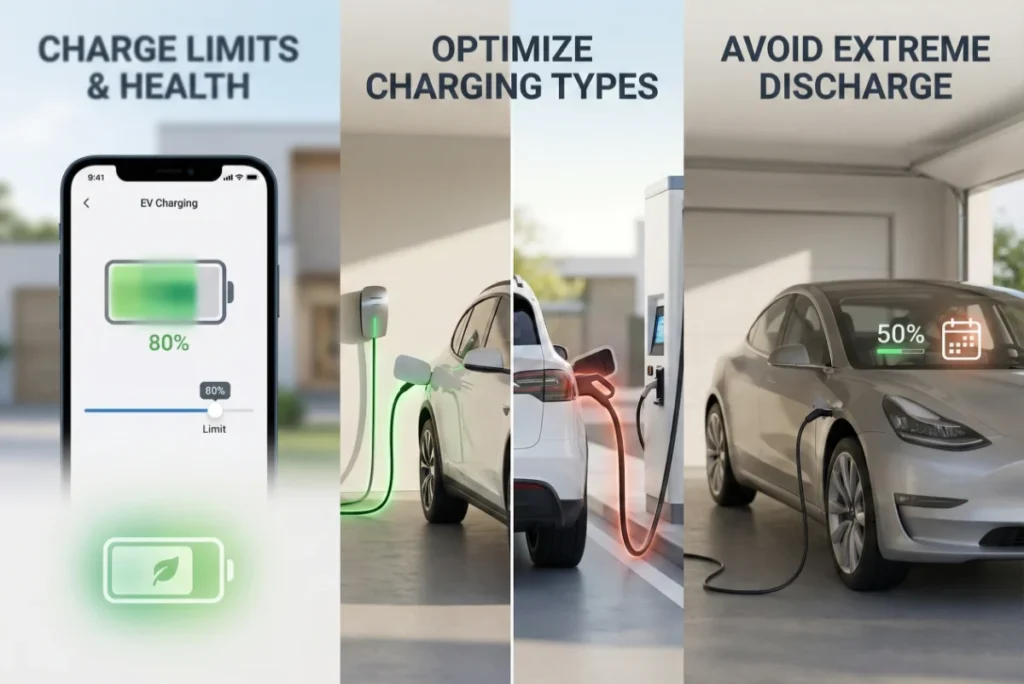
You keep your EV batteries healthy by avoiding some extreme practices: don’t let the charge get too low, don’t keep it at 100% all the time, and don’t rely on fast charging every day. Modern EV batteries are built to last, but a few simple habits can stretch their lifespan even further.
Here are some tips on how to make your electric car’s battery serve you longer:
- The 20% to 80% Rule: Lithium-ion batteries don’t like being too full or too empty, so staying in the middle of 20% and 80% is much better for them. This way, your battery will stay healthier for many years.
- Save the 100% for Road Trips: There’s no need to fully charge your EV battery every night. For the daily commute, 80% is enough for the job and puts less strain on the battery over time.
- Set a Charge Limit in the App: Many electric vehicles allow you to choose how high the battery charges with just a few taps. Once you turn this feature on, the car will handle the rest.
- Go Easy On Fast Chargers: DC chargers are great for long trips, but they add a lot of heat to the battery (we’ve mentioned it earlier). And if you use them too often, you might lose about 10% of your battery’s capacity over eight years.
- Don’t Leave It Sitting Empty: Heading overseas for a few weeks? Don’t leave your battery empty. Rather, keep it plugged in or leave it at about 50%. It’s not good for a battery to sit empty for too long.
And that’s all it takes to keep your battery in good shape.
Getting Started With Your First EV
Now you know the basics about your new electric vehicle. The first few days might feel a bit new or a little odd, and that’s completely normal. You’ll get the hang of it faster than you think. Our guide should help you feel comfortable as you settle into electric driving.
If you want more help choosing the right setup or learning how EVs work day-to-day, be sure to explore our EV beginner guides for Australian drivers. They’re easy to follow and give you everything you need to feel confident on your EV journey.