
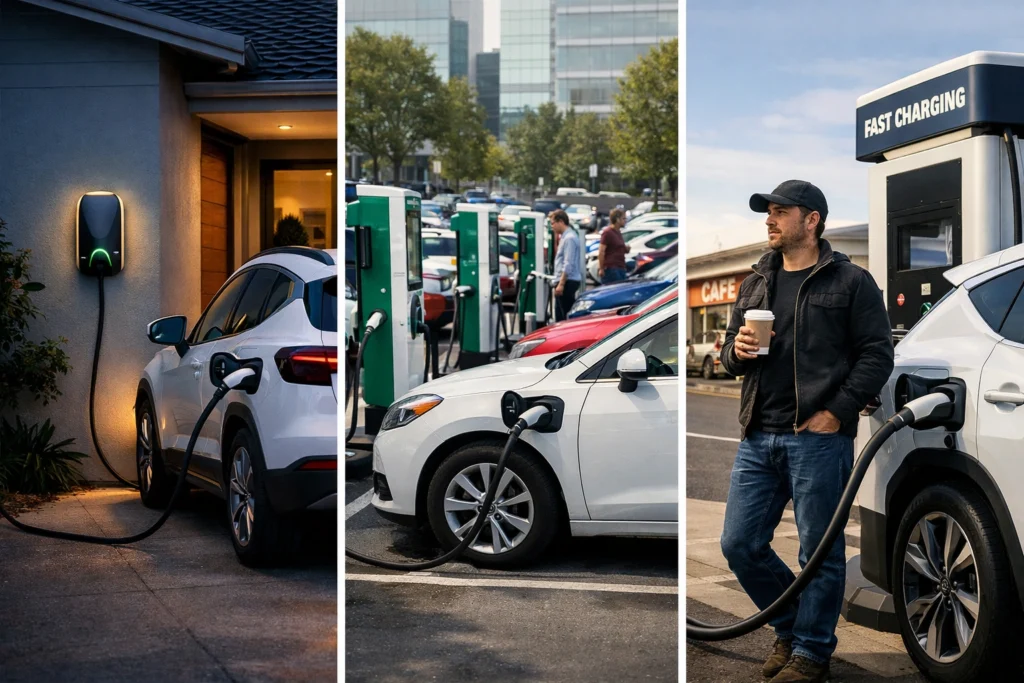
Picking the right EV charging setup can feel overwhelming when you’re new to electric vehicles. Between home chargers, workplace stations, and public options, every choice claims to be the most convenient. But if you choose the wrong one, it quickly becomes a daily frustration instead of a simple routine.
The truth is, there’s no universal answer. The best setup depends on where you park, how far you drive, and how much time you’ve got during the day. An EV that sits in your driveway overnight needs a completely different approach than one used for long highway trips across Australia.
This guide breaks down each charging option so you can match one to your actual lifestyle. Let’s start with the basics.
Which EV Charging Options Suit You?
EV charging options fall into three categories based on where you park: home chargers for overnight use, workplace stations for business hours, and public fast chargers for quick stops. Each one suits different driving habits and schedules.
Let’s take a closer look at how they compare in day-to-day use.
Home Chargers for Overnight Convenience
Home chargers let you plug in after work and recharge while you sleep. For example, a 7–11 kW unit can add roughly 40–60 km of range per hour during an overnight session. And by morning, most drivers have enough charge for the day ahead without relying on public charging stations.
Workplace Charging During Business Hours
Workplace charging works particularly well if you park at the office for six to eight hours each day. Your car charges in the background while you work, which removes the need to plan separate charging stops during the week.
Public Charging Stations for Quick Top-Ups

Say you’re on a long road trip or running errands away from home. This is when public charging stations become essential. These are usually DC fast chargers found at shopping centres and highway service stations across Australia.
And because they deliver power much faster, you can reach around 80% charge in 18–30 minutes instead of waiting all afternoon. With pay-per-use pricing and no installation required, public chargers suit drivers who need flexibility rather than daily charging.
Assess Your Parking and Daily Routine
Start by considering where your car actually sits most days. If you’ve got guaranteed overnight parking at home, a 7kW home charger handles most daily driving without stress. You plug in after work, and by morning, your EV is ready to go.
If you’re commuting 50–80 km each day, you need consistent charging access, not just occasional top-ups. In cities, home or workplace charging usually makes more sense than public stations, simply because your car is already parked for hours at a time.
For road trips over 300 km, you’ll need to plan around public fast-charging locations, especially when travelling through regional areas with fewer charging stations.
The power you need also depends on your electric car’s driving range and how you use it. Short city trips mean slower home charging is often enough. Longer distances or unpredictable schedules, on the other hand, push you toward faster public charging options to avoid range anxiety during the week.
Matching Charging Time to Your Schedule
The power level you need really comes down to how long your car is parked. Because the longer it sits, the slower the charger can be without leaving you short on range.
Here’s how that looks in practice:
- Overnight Parking (6-8 Hours): If you want a full battery by morning, a 7kW home charger does the job. For most drivers, this restores plenty of range for daily commuting without needing public charging.
- Workday Sessions (4-6 Hours): An 11-22kW charger tops up your battery during office hours. It’s ideal for workplace installations where your EV sits parked all day anyway.
- Quick Stops (1-2 Hours): You’ll need 22kW to add useful range while shopping or having lunch. These speeds give you roughly 80-120km per hour of charging, which is enough for most errands.
- Under an Hour: DC chargers at 50kW deliver fast top-ups when you’re in a rush. You’ll find them at public charging stations, though they cost more per kWh than home charging.
Match your usual parking windows to these charging speeds, and you avoid the frustration of waiting around or constantly searching for a charger.
Installing EV Chargers: What You Need to Know

Around 80% of EV drivers charge at home. That makes understanding installation basics pretty important, especially if you’re new to electric vehicles. Let’s break down what you need to know for both home and public charging setups.
Setting Up a Home Charger
Getting a home charger installed starts with getting a licensed electrician to check your electrical system. They’ll assess if your switchboard can handle the extra load and install a dedicated circuit for safe charging.
Most Australian homes with single-phase power can handle a 7kW charger without needing major upgrades, which keeps the process simple.
Once your system is ready, the next step is understanding the cost. It breaks down into two parts: wall charger units cost around $500–$2,000, and professional installation adds another $750–$1,250. In some cases, government rebates can knock several hundred dollars off the total.
Many newer chargers also include advanced features, like bidirectional charging, which lets you send power back to your home during peak tariff periods.
Finding Reliable Public Charging Stations
You don’t want to be stuck halfway through a road trip, wondering where your next charge will come from. Luckily, apps like PlugShare and Chargefox show real-time availability of public charging stations along your route.
Most Australian electric vehicles use CCS2 (Combined Charging System Type 2) connectors, which are now the standard at charging stations across the country. That includes Tesla models, so compatibility isn’t usually an issue.
Finding fast chargers is getting easier too, with infrastructure expanding across major states in 2023 and more 100kW ultrafast chargers appearing at highway service stations.
If you’re using public charging regularly, membership subscriptions typically offer lower per-kWh rates than casual pay-as-you-go pricing.
Common Mistakes EV Drivers Make

A few simple oversights can turn EV charging from convenient to frustrating. These are the mistakes that catch most EV drivers off guard:
- Installing the Wrong Charger: Putting in a 22kW charger when your electric car only accepts 11kW wastes money on capacity you’ll never use. So check your vehicle’s maximum charge rate before buying equipment.
- Relying Only on Public Charging: Public charging stations work for occasional use, but depending on them daily means competing for chargers during peak hours and paying premium rates. A home charger gives you consistent overnight charging without the hassle.
- Ignoring Off-Peak Electricity Rates: Charging during peak hours can significantly increase your electricity costs compared to off-peak rates. Simple charging habits like scheduling overnight sessions make charging far more cost-effective without changing your routine.
Most of these come down to planning ahead rather than reacting as problems show up. Get the basics right early, and charging becomes something you don’t think about.
Build a Charging Plan That Works for You
Choosing the right EV charging setup doesn’t need to be complicated. Once you’ve figured out where your vehicle parks most often and how much time you’ve got, everything else falls into place.
Start with a home charger if you’ve got reliable overnight parking. Add workplace or public charging when your routine demands it. The goal is to make sure you can charge your EV without constantly thinking about it.
Want more insights on making EV ownership simpler? Check out our latest guides on EV charging and sustainability to stay ahead of the curve.